Hanging Daybed vs Porch Swing: Which Is Right for You?
You want something that swings. Something you can sink into on a Saturday afternoon and not move for hours. But now you're stuck between two options: a classic porch swing or a hanging daybed.
They look similar in photos. They both hang from chains or rope. But the experience of using each one is genuinely different, and the right choice depends on your space, your habits, and what you're really after.
The Core Difference
A porch swing is designed for sitting. It has a back and armrests, usually seats two to three people side by side, and swings in an arc. You sit on it the way you'd sit on a bench—upright, facing forward, feet on the ground or tucked up.
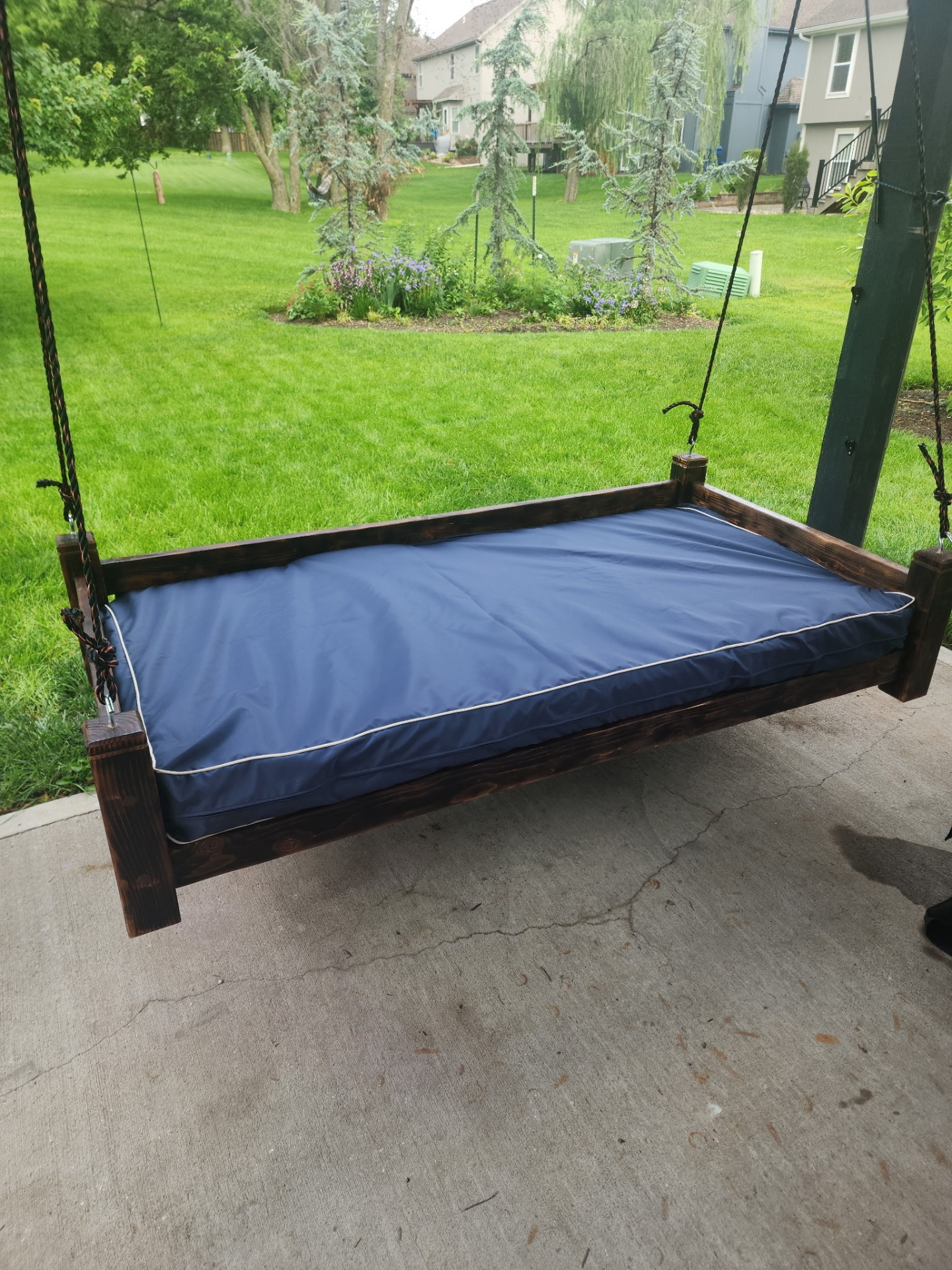
A hanging daybed is designed for lying down. It's essentially a suspended platform—flat, wide, and deep enough to stretch out on fully. We build custom hanging beds for exactly this kind of experience. Think of it as an outdoor bed that gently sways. Most daybeds are used with a full mattress or thick cushion and are meant for lounging, napping, or sprawling out with a book.
The distinction matters because it shapes everything else: how much space you need, where you put it, what it costs, and how you'll actually use it day to day.
Comfort Comparison
If comfort is your top priority, the hanging daybed wins on pure relaxation. Lying flat on a cushioned platform that gently rocks is about as close to a hammock-meets-bed experience as outdoor furniture gets. It's the piece people fall asleep on without meaning to.
A porch swing offers a different kind of comfort. It's social—you sit side by side, have a conversation, share a drink. The rocking motion is soothing but active. You're engaged with your surroundings rather than drifting off.
Neither is more comfortable in absolute terms. A swing is better for sitting and socializing. A daybed is better for lying down and unwinding. The question is which type of relaxation you reach for more often.
Space Requirements
This is where the decision gets practical. Hanging daybeds are large. A standard daybed platform is roughly 4 feet wide by 6–7 feet long, and it needs clearance on all sides to swing without hitting walls or railings. That means you need a porch or covered area that's at least 10–12 feet wide and 8–10 feet deep.
A porch swing is more compact. A 5-foot swing needs about 7–8 feet of width and 6–7 feet of depth. It tucks neatly onto a standard front porch or under a pergola without dominating the space.
If your porch is under 10 feet wide, a daybed probably won't fit comfortably. If you have a deep covered patio, a screened porch, or a large pergola, a daybed could be the perfect centerpiece.
Best Use Cases for Each
Choose a Porch Swing If:
- You want a front porch gathering spot
- Your space is moderate (standard 8–12 foot porch)
- You picture sitting upright with coffee, conversation, or a view
- You want seating that looks classic and familiar
- You have kids who will use it as a play spot
Choose a Hanging Daybed If:
- You want an outdoor napping or reading spot
- You have a large covered patio, screened porch, or pergola
- You picture lying flat with pillows, a blanket, and nowhere to be
- You want a statement piece that feels luxurious
- You're building a dedicated relaxation zone in your yard
Hanging and Structure
Both need serious structural support, but daybeds demand more of it. A porch swing with two adults might weigh 250–400 pounds total (swing plus people). A daybed with a mattress and two adults can easily reach 500–700 pounds.
Daybeds typically hang from four points (one at each corner), while swings hang from two. That means four anchor points in your ceiling, each rated for the load, and ideally connected to structural beams or a purpose-built frame.
If you're hanging a daybed from an existing porch ceiling, you'll want to verify that the framing can handle the weight. Many homeowners opt to hang daybeds from a dedicated pergola or freestanding frame instead, which eliminates the guesswork about ceiling structure. Take a look at our hanging daybed build for an example of how we approach this.
For porch swings, two heavy-duty screw eyes into ceiling joists are usually sufficient. It's a simpler installation with fewer variables.
Style and Curb Appeal
A porch swing is timeless. It reads as classic, welcoming, and approachable. It belongs on a front porch the way a mailbox belongs at the curb—it just fits. Neighbors wave, kids stop to look, and the whole front of the house feels warmer.
A hanging daybed is more of a statement. It reads as intentional, curated, and a little bit indulgent. It works beautifully on a back patio, a screened porch, or under a pergola where it becomes the focal point. On a front porch, it can look stunning if the porch is large enough, but it's less common and more eye-catching.
Think about where the piece will live and what message you want the space to send. A swing says "come sit with me." A daybed says "this is where I disappear for the afternoon."
Cost Comparison
Hanging daybeds cost more than porch swings. The platform is larger, uses more material, and requires heavier hardware. A custom-built wooden porch swing might run $500–$1,200 depending on size and finish. A custom hanging daybed typically starts around $1,500 and can go well above $3,000 for larger builds with premium materials.
You'll also spend more on the daybed's cushion or mattress. An outdoor-rated mattress that fits a daybed platform runs $200–$600, while porch swing cushions are typically $50–$150.
Factor in the structural requirements too. If you need to reinforce your ceiling or build a frame to support a daybed, that adds to the project cost. Porch swings are generally simpler and cheaper to install.
Which One Should You Choose?
Start with how you'll actually use it. Close your eyes and picture your ideal outdoor moment. Are you sitting upright, rocking gently, watching the street? That's a porch swing. Are you lying flat, eyes closed, half asleep with a breeze on your face? That's a daybed.
Next, check your space. Measure the area where you'd put it. If the numbers work for a daybed and that's what you want, go for it. If the space is tight, a porch swing will serve you better without compromises.
Finally, consider your budget. If the daybed is a stretch financially, a well-built porch swing is not a consolation prize—it's a genuinely great piece of outdoor furniture that you'll use for years. And you can always add a daybed later when the budget and the space align.
Not sure what works for your space? Send us your measurements and we'll help you figure out what fits.
Related Projects
Want a custom porch swing or hanging daybed built for your space?
Contact Good Woodin Co for pricing, build details, and pickup information in Lee's Summit.